Man with a "Real Job" here.
I spent years as a "PowerPoint janitor" in Big Tech strategy. Here is the full story of that high-stakes, 100-page deck world—and how we’re finally using AI to automate the manual labor.

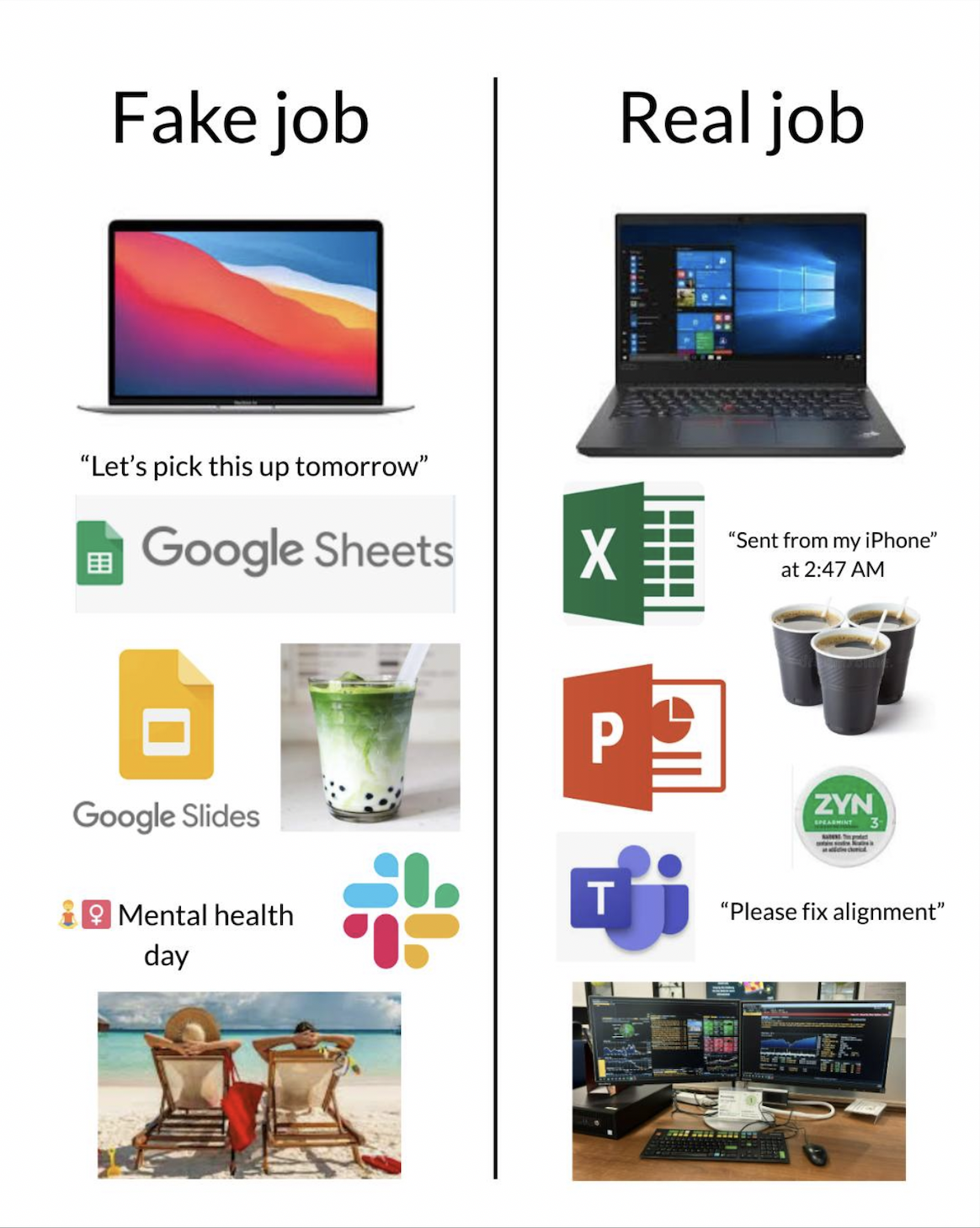
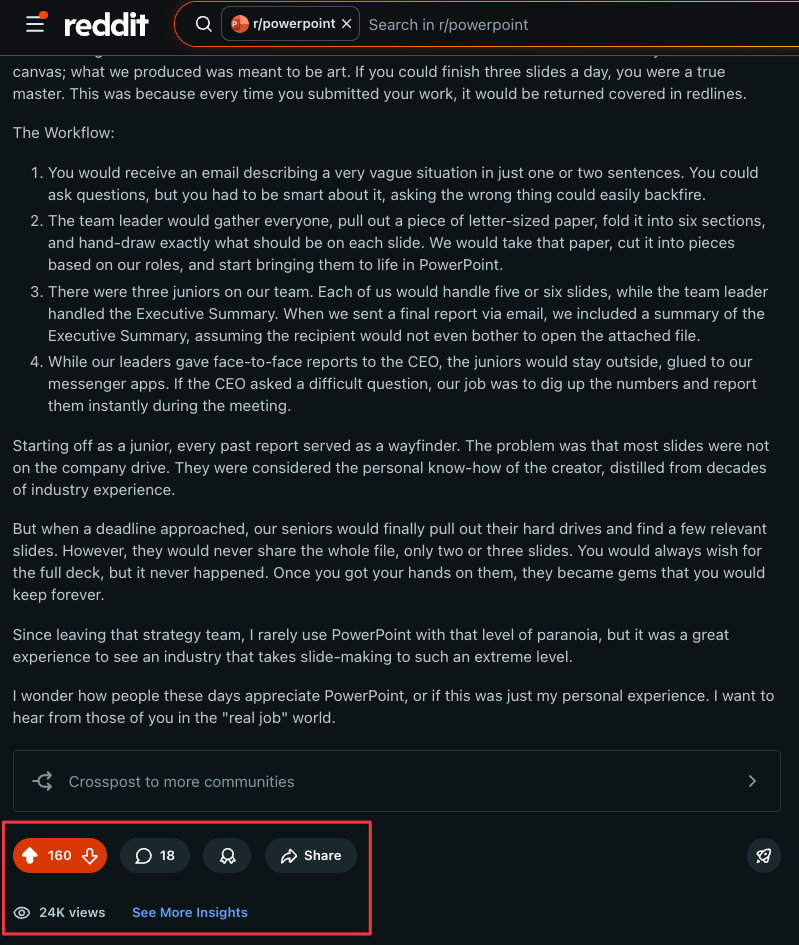
Recently, I wrote a short post on Reddit about my "fake job vs. real job" experience. It went viral, hitting 24k views and 160 upvotes in less than six hours. Here is my full story. If you are currently working a "real job," subscribe for more content like this.
Now that I am working a "fake job" at a startup, seeing this meme brought back a flood of memories. Back in 2018, while I was an internal strategy consultant at a Big Tech firm, I made more PowerPoints than I ever thought possible. We were the "CEO Staff" team, an honorable elite responsible for everything from market research and KPI reporting to whipping other teams during performance reviews. 🤣
On my first day, we had an internal class where we had to read Barbara Minto’s The Pyramid Principle. It was the must-read for anyone aspiring to be a true management consultant. We even had quizzes and had to create summary decks to prove we had consumed the entire brick.
Our team’s goal was to create "kick-ass" slides. We were trained to use PowerPoint the way Da Vinci used a canvas; what we produced was meant to be art. If you could finish three slides a day, you were a true master. This was because every time you submitted your work, it would be returned covered in redlines.
The Workflow:
- You would receive an email describing a very vague situation in just one or two sentences. You could ask questions, but you had to be smart about it, asking the wrong thing could easily backfire.
- The team leader would gather everyone, pull out a piece of letter-sized paper, fold it into six sections, and hand-draw exactly what should be on each slide. We would take that paper, cut it into pieces based on our roles, and start bringing them to life in PowerPoint.
- There were three juniors on our team. Each of us would handle five or six slides, while the team leader handled the Executive Summary. When we sent a final report via email, we included a summary of the Executive Summary, assuming the recipient would not even bother to open the attached file.
- While our leaders gave face-to-face reports to the CEO, the juniors would stay outside, glued to our messenger apps. If the CEO asked a difficult question, our job was to dig up the numbers and report them instantly during the meeting.
The Death of the 100-Page Redline.
Looking back, we spent 10% of our time on strategy and 90% on formatting. That’s why we’re building Contrl. It’s the tool I wish I had when the CEO asked a question I didn't have a slide for.
Imagine an AI that takes your internal KPIs and external market data and updates a 100-page PowerPoint template instantly, without breaking the template. No more 'manual janitor' work.
Starting off as a junior, every past report served as a template or reference guide. The problem was that most slides were not on the company drive. They were considered the personal know-how of the creator, distilled from decades of industry experience.
But when a deadline approached, our seniors would finally pull out their hard drives and find a few relevant slides. However, they would never share the whole file, only two or three slides. You would always wish for the full deck, but it never happened. Once you got your hands on them, they became gems that you would keep forever.
Since leaving that strategy team, I rarely use PowerPoint with that level of paranoia, but it was a great experience to see an industry that takes slide-making to such an extreme level.
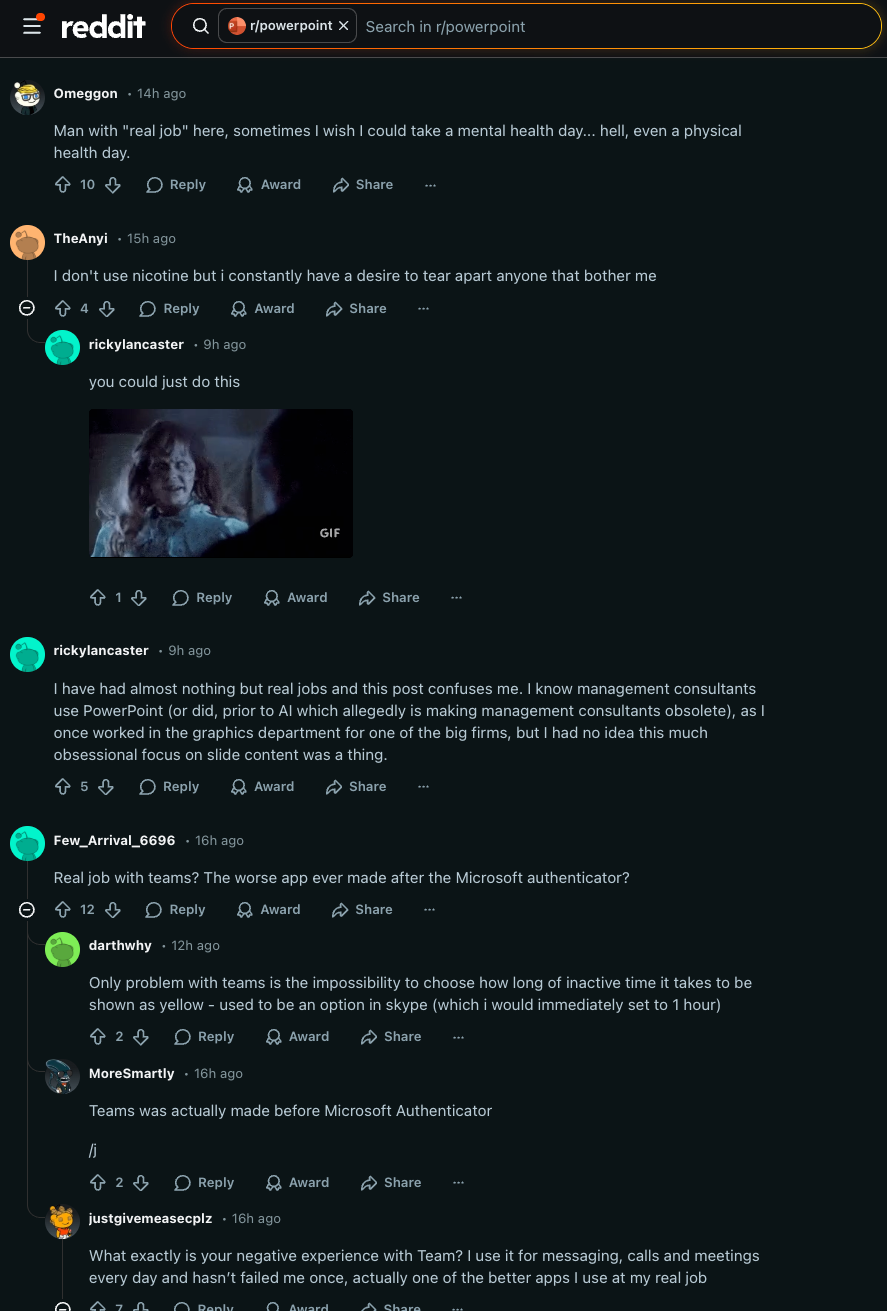
I wonder how people these days appreciate PowerPoint, or if this was just my personal experience. Subscribe if you want to hear more from the "real job" world.
Q: What is the Pyramid Principle in consulting?
A communication framework by Barbara Minto that focuses on 'Answer First' logic
Q: How is AI changing PowerPoint deck creation?
Contrl is an AI tool designed to automate PowerPoint deck creation by syncing live data directly into existing 100-page enterprise templates without formatting errors.